
Australian Study Finds Family Members, Not Institutions, Drive Most Childhood Physical Abuse
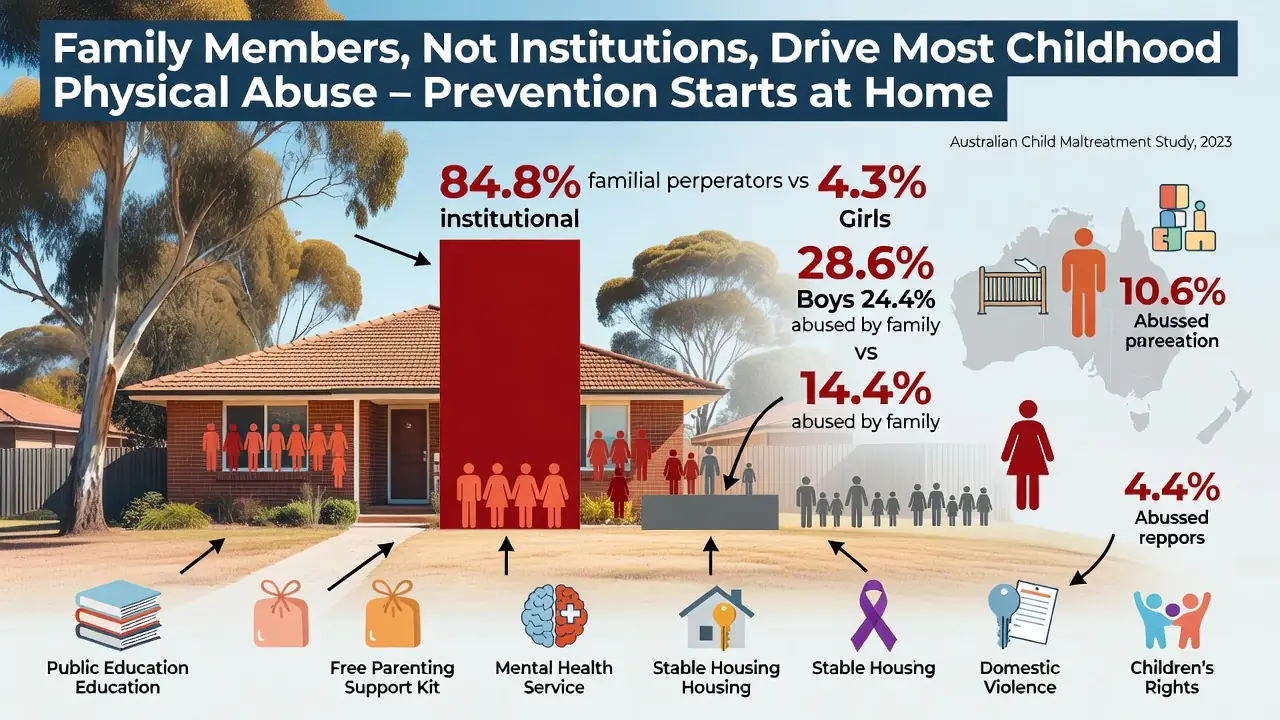
A new analysis of data from the Australian Child Maltreatment Study looks at who carries out physical abuse against children and when it most often happens. The findings point to the home as the main setting for harm, and they suggest that prevention efforts need to reach families before violence starts.
Who is responsible for the abuse
The researchers examined 2,623 people who reported physical abuse during childhood. They compared two groups of perpetrators: familial perpetrators, such as parents, step-parents, parents' partners and adult relatives, and institutional perpetrators, such as teachers, coaches and adults in religious organisations. Familial perpetrators were responsible for the overwhelming majority of cases. Children were 20 times more likely to be abused by a family member than by an institutional adult, at 84.8 percent compared with 4.3 percent.
Girls were somewhat more likely than boys to report abuse by a family member, at 28.6 percent compared with 24.4 percent. The authors argue that although prevention work has often concentrated on abuse in schools and sports, far more attention needs to go to the home.
Patterns by parent and age
About one in three adults who reported abuse before age ten said both parents were responsible. When only one parent was the abuser, boys were about twice as likely to name their father (10.6 percent) as their mother (4.4 percent). No comparable gap appeared among girls. The study's authors note that this result runs against earlier research that identified fathers as the most common or only abusers.
What would reduce physical abuse
The authors call for a shift from responding to abuse toward preventing it. Their recommendations include broader public education so that parents, teachers and clinicians can recognise warning signs, along with free, evidence-based parenting support available to every family. They also point to access to mental health care, substance use services, stable housing and programs addressing domestic violence, since stress within a household raises the risk to children. Children themselves need clear information about their rights and safe ways to seek help. Existing campaigns about acceptable adult behaviour focus mainly on sexual abuse, and the researchers say comparable campaigns are needed for physical abuse.
The study is observational and relies on adults recalling their childhood experiences, so it shows patterns rather than causes. Its central message, however, is that physical abuse is preventable when support reaches families early.